
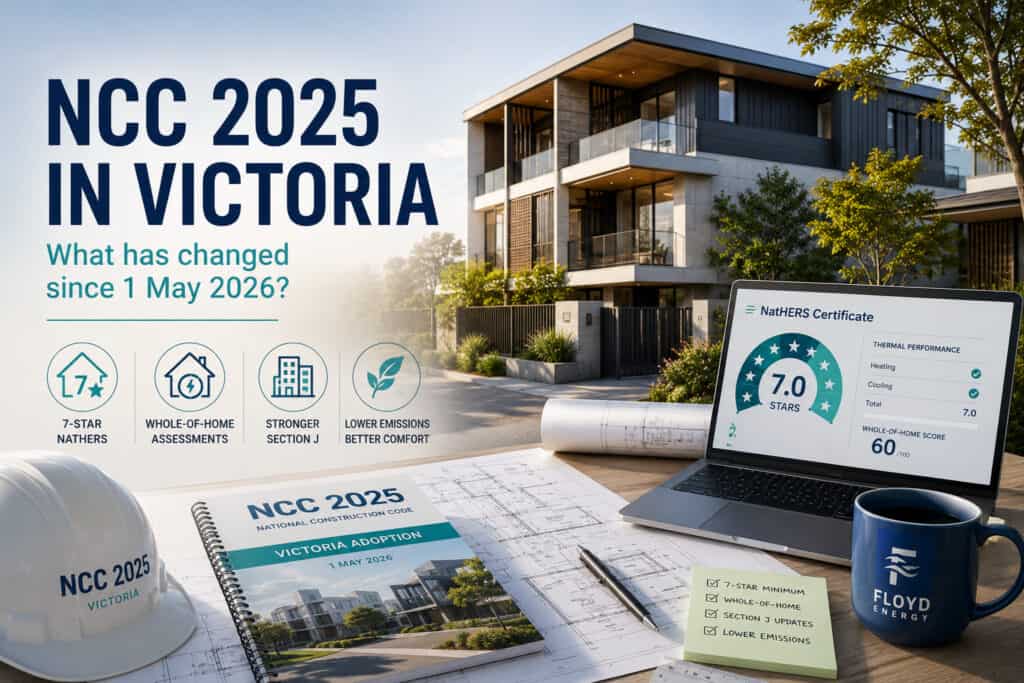
Victoria’s adoption of the National Construction Code (NCC) 2025 on 1 May 2026 marked another
important step toward buildings that are more comfortable, energy efficient and lower in emissions.
While NCC 2025 introduced new measures, the most significant practical impacts for many residential
projects still come from the NCC 2022 energy efficiency reforms, which became mandatory in Victoria in
May 2024. These reforms require all new homes and major renovations to achieve a minimum 7-star
NatHERS thermal performance rating, lifting the benchmark from the long-standing 6-star standard. In
practice, this means better insulation, improved glazing, tighter sealing, smarter shading and stronger
overall building envelope performance — all designed to reduce the energy needed for heating and
cooling. In Victoria’s climate, this uplift can typically cut heating and cooling energy use by around
20–25% compared with previous standards.
Another important shift is the introduction of the “Whole-of-Home” energy budget assessment. Instead
of looking only at the thermal shell of the dwelling, the NCC now takes a broader view of how the home
performs in real life. The assessment considers the efficiency of fixed appliances and systems such as
heating, cooling, hot water, lighting and pool equipment, while allowing rooftop solar to offset some
energy use. For detached homes in Victoria, this generally means achieving a Whole-of-Home score of at
least 60 using NatHERS assessment tools.
For commercial buildings, NCC 2025 brings more substantial change. The updated code strengthens
Section J energy efficiency provisions and further aligns the built environment with Australia’s net-zero
emissions pathway. Key areas of focus include stronger building fabric performance, improved air
sealing, electrification readiness, solar PV integration and EV charging infrastructure. These changes will
be especially relevant for Class 3–9 buildings and the common areas of apartment developments.
Taken together, Victoria’s implementation of NCC 2025 signals a clear move away from simple minimum
compliance and toward measurable, real-world energy performance. Designers and builders will need to
place greater emphasis on airtightness, condensation management, thermal bridge reduction, higher-
performing glazing and efficient all-electric services.
The result is a stronger focus on buildings that arenot only compliant, but more comfortable to live and work in, cheaper to run over time and betteraligned with long-term emissions reduction goals.